

The more useful question is not “How many citations do I need?” It is “Is inaccurate, contradictory or weak third-party business information actually one of the constraints holding this business back?”
That distinction matters because citation correction and citation volume are not the same job. If important sources disagree about your business name, address, phone number, location or website, fixing those contradictions can make sense. If the important sources are already accurate, spending month after month submitting the same business to increasingly obscure directories can become a poor use of budget.
What local citations actually corroborate
A local citation is a third-party reference to a business. Depending on the source, that reference can contain a business name, address, phone number, website, category, opening information or other identifying details.
The useful role is corroboration.
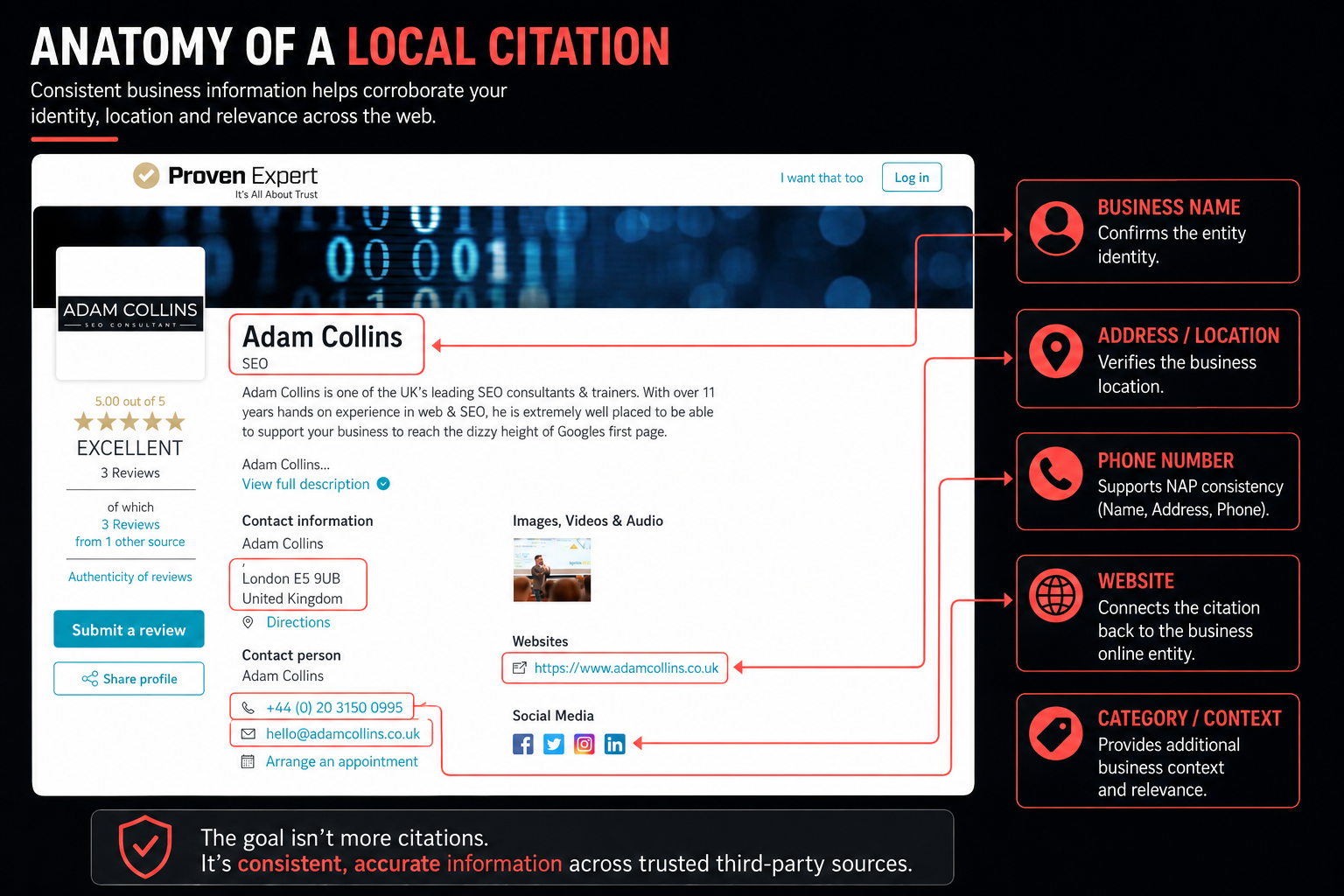
Your website and Google Business Profile tell search systems what the business says about itself. Relevant third-party sources can provide independent confirmation that the same entity, location and business details exist elsewhere.
That makes citation work primarily an entity-consistency problem, not a game of collecting the largest possible directory count.
If ten worthwhile sources accurately describe the same business, I would rather have that than fifty weak listings containing old addresses, duplicate profiles, inconsistent business names or irrelevant category information.
Consistency matters more than raw citation volume
The classic citation playbook was simple: submit the business to as many directories as possible and keep the name, address and phone number consistent.
That is too crude.
Consistency still matters for the core facts that identify the business. If your current address is correct on your website but an old location is still appearing across prominent third-party sources, that is something I would investigate and clean up.
But not every field on every citation needs to be mechanically duplicated, and not every directory deserves your time merely because it accepts submissions.
I would prioritise sources based on questions such as:
- Does the source actually appear when people or search engines research the business?
- Is it relevant to the business’s industry or geographic market?
- Is the listing indexed and discoverable?
- Does it contain incorrect or conflicting entity information?
- Does it have an existing profile that should be corrected rather than duplicated?
- Is there a realistic reason for customers or search systems to encounter it?
That produces a much smaller and more defensible job than blindly working through a spreadsheet of hundreds of directories.
When citation correction deserves priority
I would move citation work up the Local SEO priority list when there is a clear consistency or entity problem.
| Situation | My call | Why |
|---|---|---|
| Important sources show an old address, phone number or business name | Prioritise correction | Multiple conflicting versions of the same business create an unnecessary entity-consistency problem. |
| A business has moved, rebranded or changed contact details | Audit first | Legacy references can persist after the business itself has changed. |
| Major industry or locally relevant sources are missing | Fill the worthwhile gaps | A small number of genuinely relevant sources can provide better corroboration than bulk generic submissions. |
| Core business data is already accurate across the important sources | De-prioritise volume | Another batch of low-value listings may not be the constraint preventing growth. |
| The site has weak commercial pages, poor GBP setup, technical problems or little authority | Diagnose the broader campaign | Citations are only one Local SEO intervention and may not be the highest-ROI next action. |
When I would not keep paying for more citation submissions
If the important business information is already correct, I would not automatically keep a monthly citation-building programme running just because “citations are good for Local SEO”.
There needs to be a reason for the next submission.
Perhaps a relevant industry directory is missing. Perhaps a prominent local source contains the wrong address. Perhaps a competitor review shows that an important source ecosystem has been overlooked.
Fine. Fix it.
But once the meaningful gaps are closed, the next pound may be better spent improving the Google Business Profile, strengthening a location or service page, acquiring relevant authority, fixing technical problems, generating legitimate reviews or improving conversion.
That is why citation work should sit inside a broader Local SEO strategy rather than operating as an endless standalone deliverable.
What the Shortland Horne campaign actually showed
Shortland Horne is a Coventry estate agency that worked with Ignite SEO on a long-running Local SEO campaign beginning in 2016.
Citation building formed part of that campaign, so the case is useful here. But it is important not to rewrite a multi-intervention campaign into a neat citation-only success story.
The wider work included:
- Local SEO strategy
- keyword research
- commercial local content
- technical SEO and crawlability improvements
- link building
- citation building
- Google Business Profile and local optimisation
- later PR supporting geographic expansion
The reported campaign results included sustained page-one visibility for important Coventry searches, a client-reported top-three position for competitive primary keywords within six months, growth in referring domains over the longer campaign and substantial activity through the Google Business Profile.
What can I reasonably conclude? Citation work was one of the Local SEO interventions used while the business improved its wider search visibility.
What can I not conclude? I cannot isolate citations and claim they independently caused the rankings, website traffic, calls or wider campaign growth.
That causal boundary is important. SEO campaigns rarely change one variable at a time, and pretending otherwise makes the case study sound cleaner than the evidence really is.
If you want to review the underlying campaign context, Ignite SEO has published the Shortland Horne estate agency SEO case study.
Observed, plausible and unproven
| Evidence level | What we can say |
|---|---|
| Observed in the campaign | Citation building was carried out alongside technical SEO, content, links, GBP work and other Local SEO activity. |
| Plausible contribution | Accurate third-party business references can support entity and location corroboration as part of the wider local search ecosystem. |
| Not causally isolated | The campaign does not prove that citations alone caused ranking, traffic, call or lead improvements. |
| Decision implication | Use citation work when the diagnosis shows a meaningful consistency or source gap rather than treating submission volume as the objective. |
How I prioritise citation work in a Local SEO audit
I normally start with the business’s actual source of truth: its current name, address, phone number, website, locations and primary service information.
Then I look outward.
- Identify contradictory information. Find prominent third-party sources carrying old or incorrect business data.
- Separate valuable sources from noise. Prioritise prominent local, industry and entity-relevant sources rather than every directory that accepts a form submission.
- Correct before expanding. Cleaning up an existing wrong listing is generally more useful than creating another weak one.
- Fill obvious source gaps. Add worthwhile listings where the business genuinely belongs and where the source contributes useful corroboration or visibility.
- Reassess the constraint. Once the meaningful citation work is complete, move budget to the next Local SEO bottleneck instead of manufacturing more citation tasks.
This is also why I would not judge a citation campaign by the number of listings delivered. The useful output is a more accurate and credible representation of the business across the sources that matter.
Citations are one signal inside a larger Local SEO system
Local visibility is rarely fixed by one lever.
A business can have perfectly consistent citations and still underperform because its Google Business Profile is poorly configured, its primary category is wrong, its location pages do not satisfy commercial intent, its reviews are weak, its site lacks authority or Google cannot crawl important pages properly.
For the wider relationship between relevance, distance, prominence, reviews, citations and authority, see what actually drives Google Maps visibility.
Equally, there is little sense pouring money into links or new content whilst prominent third-party sources still disagree about where the business is located.
The job is diagnosis.
If citation consistency is the constraint, fix it. If it is not, stop buying more citations and move onto the thing that is actually suppressing commercial visibility.
Not sure whether citations are actually your Local SEO problem?
I work directly with businesses on Local SEO strategy and diagnosis. That means looking at the full system — Google Business Profile, local landing pages, reviews, citations, authority, technical issues and measurement — and prioritising the work most likely to make a commercial difference.
If your business has already spent money on Local SEO but you are not sure whether the next move should be citation cleanup, GBP work, content, links or something else, start with the diagnosis rather than another package.