

I don’t start an engagement with a predetermined list of technical fixes, content pieces or links to build. I start by understanding the business, reviewing the evidence and diagnosing the problems before prescribing the work.
For retained SEO consultancy, my first month normally moves through five stages: a business deep dive, existing performance analysis, semantic foundations, quick wins and a prioritised six-month growth plan.
After that, the relationship becomes an ongoing cycle of implementation, measurement and reprioritisation.
Considering SEO consultancy but unsure what actually needs doing?
I can review where organic search currently sits, what is constraining growth and which SEO priorities are worth acting on first.
What happens before an SEO consultant makes recommendations?
Before I make meaningful SEO recommendations, I need to establish the commercial context of the business and the current state of its organic performance.
That means understanding more than rankings and traffic. I want to know what you sell, which products or services matter most, who buys them, where the commercial priorities sit and what resources are realistically available to execute SEO work.
I will usually want to understand:
- how the business makes money;
- which services or products are commercially important;
- who the target customers are;
- which markets or locations matter;
- what marketing is already working;
- what has previously been attempted with SEO;
- who the meaningful search competitors are; and
- which internal teams or suppliers can implement the work.
I will also need access to the relevant website, search and analytics data where available.
The point is simple: diagnosis should come before prescription. An SEO recommendation can be technically correct and still be commercially useless if it is solving the wrong problem.
What happens during the first month of SEO consultancy?
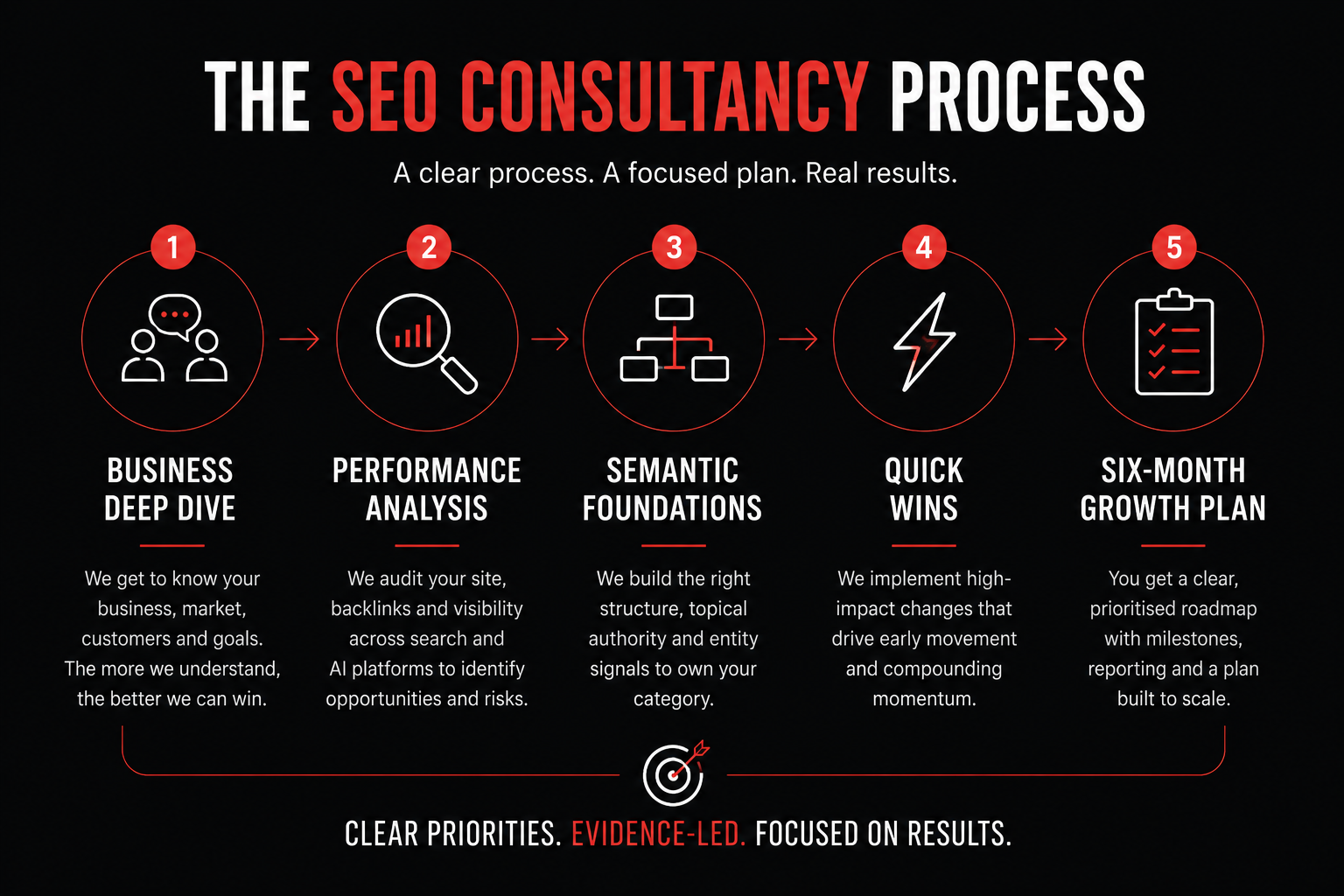
The first month of my retained SEO consultancy is designed to turn business context and search data into a prioritised growth plan.
The exact work changes from site to site, but the process normally has five stages.
1. Business deep dive
The business deep dive establishes the commercial context that the SEO strategy needs to support.
I want to understand the business model, customers, products or services, current marketing position and the areas where growth actually matters.
This affects how I prioritise opportunities.
The keyword with the largest search volume is not automatically the best target. A smaller search opportunity connected to a more valuable service, stronger margin or strategically important customer can be worth considerably more.
SEO should support the business rather than becoming an isolated exercise in generating traffic.
2. Existing performance analysis
Existing performance analysis identifies what is already working, what is constraining growth and where credible opportunities exist.
I look at the evidence available across the site and its current search performance rather than assuming every business needs the same SEO treatment.
Depending on the website, the constraint could involve technical SEO, page quality, site architecture, internal linking, weak authority, competing URLs, poor search-intent alignment or several of those things at the same time.
This is why I don’t like starting an engagement with a generic SEO checklist.
For Fleet Evolution, for example, the work ultimately included an SEO audit, the removal or consolidation of more than 500 low-quality and duplicate pages, improvements to existing content and the homepage, supporting content, internal linking, link acquisition, digital PR and technical fixes.
No single intervention produced the result. It was a combination of workstreams identified and prioritised around the site’s actual constraints.
Across the campaign, organic visits increased from 2,466 to 9,598 and goal completions increased from 179 to 464.
Already doing SEO but unsure whether you’re solving the right problems?
I can review the current strategy, the evidence behind it and whether the work being prioritised actually matches the constraints holding the site back.
3. Semantic foundations
Semantic foundations define which pages should own which topics and search intents, and how those pages should relate to each other.
Before recommending another batch of content, I want to know whether the site already has the right URLs and whether those URLs have clear jobs.
That means working out:
- which page should own each important search intent;
- which new pages genuinely need to exist;
- which pages should not exist;
- where multiple URLs are competing for the same job;
- how commercial and supporting pages should connect; and
- whether the important entities and topics are represented clearly across the site.
This is particularly important on established websites where years of publishing can leave several pages saying slightly different versions of the same thing.
Creating more content isn’t always growth. Sometimes the better move is deciding which page should win and consolidating everything around it.
4. Quick wins
Quick wins prioritise changes that have a credible opportunity to improve performance without waiting for the wider six-month plan to be completed.
That might mean improving an existing page already close to performing, fixing internal linking, consolidating competing URLs or removing a technical constraint from an important part of the site.
I don’t call something a quick win simply because it is easy to implement.
It still needs an evidence-based reason to improve the outcome we’re trying to influence.
5. Six-month SEO growth plan
The first month produces a prioritised six-month SEO growth plan that I present and remain responsible for strategically.
The plan turns the diagnosis into decisions: what should happen first, what depends on other work, what can wait and what probably isn’t worth doing at all.
That last part matters.
A useful consultant should be able to tell you what not to spend time and money on as well as producing another list of things you could theoretically optimise.
The result should be a clear understanding of where organic growth can come from and what needs to happen next.
What should you expect to receive from an SEO consultant?
A good SEO consultancy engagement should leave you with clearer priorities, defined responsibilities and an evidence-based plan for improving organic performance.
The exact deliverables vary according to the business and the engagement, but you should understand:
- where organic search currently stands;
- what is already working;
- what is constraining performance;
- where the strongest opportunities sit;
- which pages and topics matter;
- what should happen first;
- who is responsible for implementation;
- what performance will be reviewed; and
- what evidence would cause the strategy to change.
For my retained consultancy clients, the main first-month output is the six-month growth plan rather than a collection of disconnected audits.
Who implements the SEO recommendations?
Implementation depends on the resources already available inside the business, while I remain responsible for the SEO strategy and direct consultancy relationship.
If you already have developers, writers, designers or an internal marketing team, I can work directly with those people and provide the priorities, requirements and strategic direction they need.
Where additional execution capacity is required, the team at Ignite SEO can also support implementation.
Ignite SEO is a separate agency. Hiring me for retained consultancy does not mean the strategic relationship is handed to an anonymous agency account manager.
I remain your direct consultant and strategy owner.
Equally, that doesn’t mean I personally need to upload every page, change every line of code or complete every implementation task myself.
My responsibility is making sure the right work is identified, properly prioritised and moving in the right direction.
Have an internal team but need somebody to own the SEO direction?
I can work with your existing developers, content team and marketing resources while owning the diagnosis, priorities and ongoing SEO strategy.
What happens after the initial SEO strategy is agreed?
After the initial plan is agreed, SEO consultancy becomes a cycle of implementation, measurement and reprioritisation.
The six-month plan gives us direction, but it shouldn’t become a document that everybody follows blindly regardless of what happens next.
Once work is implemented, we get new evidence.
Some pages move faster than expected. Some don’t. New constraints appear. Competitors change. Search results change. Development work gets delayed. Commercial priorities inside the business can change as well.
I review what is happening and use that information to decide whether the priority order still makes sense.
If the evidence changes, the plan can change.
How is progress reviewed during an SEO consultancy engagement?
SEO progress should be reviewed against the commercial objective and the search performance that is supposed to influence it.
I don’t think the purpose of reporting is to prove that lots of SEO activity happened during the month.
The useful questions are more direct:
- Has visibility changed where it matters?
- Are the priority pages moving?
- Is organic traffic improving in commercially useful areas?
- Are enquiries, sales or relevant conversion actions moving?
- Which implemented changes appear to be working?
- What is still holding performance back?
- Does the next priority still deserve to be the next priority?
Reporting should help make the next decision. If it only describes the previous month’s activity, it isn’t doing enough.
Can SEO priorities change during the engagement?
SEO priorities should change when new evidence makes the existing priority order less commercially useful.
I would rather change the plan than spend another four months proving that we can follow a spreadsheet.
That doesn’t mean changing strategy every time a keyword moves three positions.
It means keeping the commercial objective stable while being prepared to change the route when the evidence justifies it.
How does the structure of an SEO engagement affect cost?
The structure of the engagement affects cost because strategic consultancy, implementation requirements and the resources needed to execute the work can vary substantially between businesses.
A company with an established development and content team may need a different consultancy model from a business that needs strategy and implementation capacity.
I cover the pricing side separately in my guide to how much an SEO consultant costs, rather than turning this page into another pricing article.
What if you’re still deciding which SEO consultant to work with?
If you’re still comparing consultants, the important question is whether the person you hire can connect diagnosis, priorities and execution to the commercial outcome you actually care about.
I cover the selection process separately in my guide to how to choose an SEO consultant, including the things I would look at before agreeing to work with somebody.
What should you expect from me as your SEO consultant?
You should expect me to remain directly responsible for the strategic direction of the SEO engagement.
I’ll ask questions about the business before recommending tactics. I’ll look at what the evidence says before deciding what deserves attention. I’ll tell you what I think is worth doing, and I’ll also tell you when I don’t think something deserves the time or budget.
I won’t create work simply because another month of the retainer has started.
Sometimes the right next step is a new piece of work. Sometimes it’s implementing what we’ve already identified. Sometimes it’s stopping something that isn’t producing enough value. Sometimes new evidence means the priority changes completely.
The point of the relationship is not to keep an SEO retainer busy.
It’s to keep organic search pointed at the commercial objective.
Want to know what an SEO consultancy engagement would look like for your business?
I’ll look at where you are now, what you’re trying to achieve and whether there is a useful SEO opportunity for me to help with.