

That strategy can cover technical SEO, content, site architecture, internal linking, backlinks, local SEO and AI search visibility.
An SEO consultant’s value is not producing a longer list of SEO tasks. It is deciding which work matters, what happens first and what is not worth doing at all.
Most established websites have hundreds of potential changes that could be made. The consultant diagnoses the constraint between where the business is now and where it wants to be, then determines the most commercially sensible route between the two.
What Does an SEO Consultant Do?
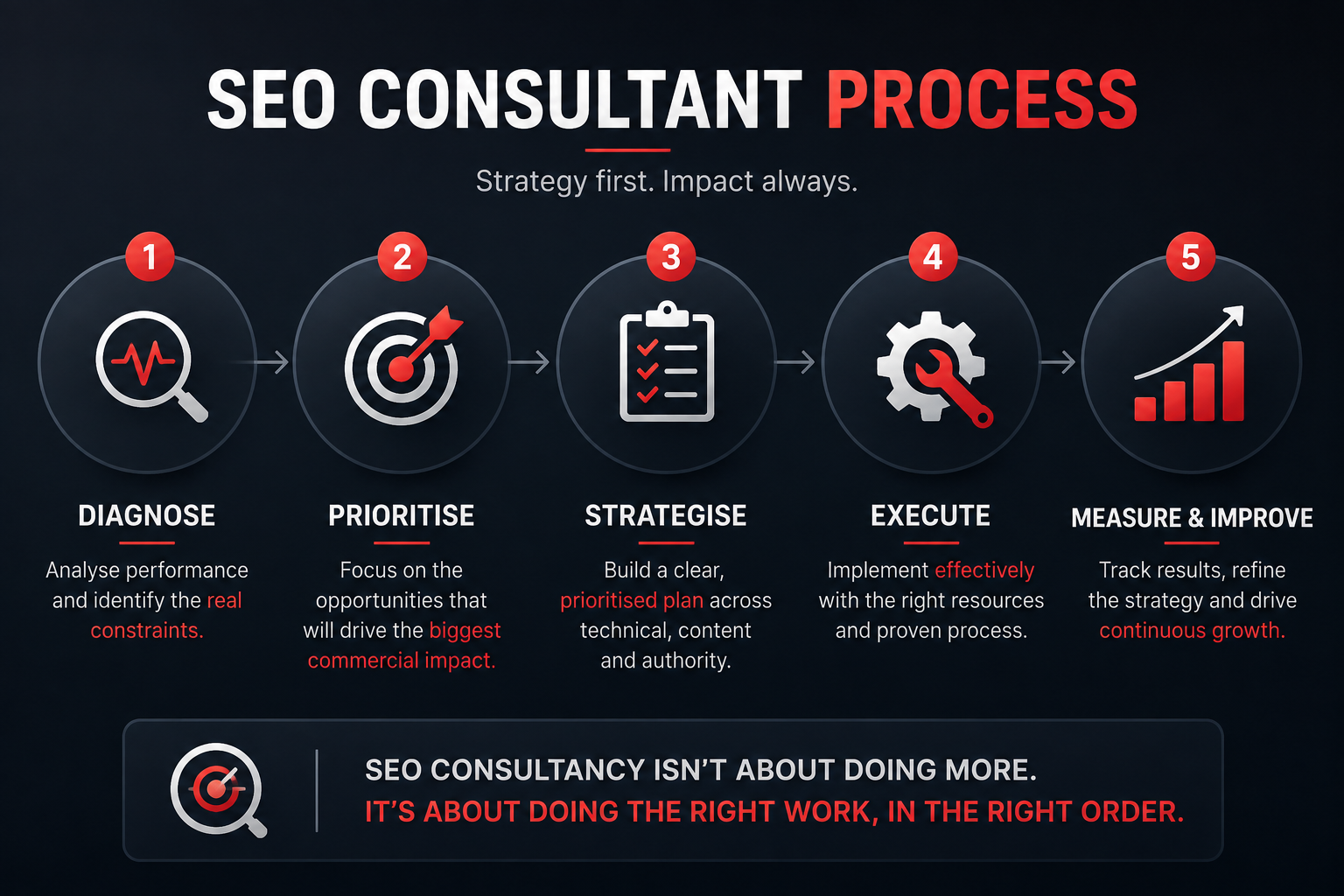
An SEO consultant diagnoses SEO problems and opportunities, prioritises them according to their likely commercial impact, and builds a strategy for improving organic search performance.
The exact work depends on the business, the website and the competitive landscape.
| Area | What an SEO consultant does |
|---|---|
| SEO strategy | Identifies where organic growth can come from and prioritises the work required |
| Technical SEO | Diagnoses crawling, indexing, rendering, architecture and other technical issues |
| Search and competitor research | Analyses what customers search for and what currently wins those searches |
| Content | Determines what should be created, improved, consolidated or removed |
| Site architecture | Establishes which pages should exist, what each page should target and how they connect |
| Internal linking | Distributes relevance and authority between important pages |
| Backlinks and authority | Assesses whether authority is limiting rankings and where links or mentions are required |
| Local SEO | Improves visibility across local organic search and Google Maps where relevant |
| AI search | Evaluates how the business, its entities and its information appear across AI-driven search experiences |
| Measurement | Connects organic search performance to leads, sales and other commercial outcomes |
The operative word is diagnoses.
Organic leads falling by 30% does not make “do more SEO” a useful recommendation. I establish what changed first.
Did rankings decline? Which pages and queries lost visibility? Did competitors improve? Did search demand change? Has Google changed the result type it rewards? Are multiple pages competing for the same intent? Is organic traffic stable while conversion performance has fallen?
Prescribing the work only makes sense once the constraint is understood. That is the difference between SEO activity and SEO consultancy.
Does an SEO Consultant Implement the Work?
An SEO consultant can provide strategic advice alone or combine consultancy with implementation, depending on the client’s internal resources and the type of support required.
Some businesses already have developers, writers, marketers or an in-house SEO team capable of implementing the work. In those cases, the consultant can focus on diagnosis, priorities and strategic direction.
Where execution is also required, consultancy can be combined with delivery resources while the consultant remains responsible for the strategy.
When Should You Hire an SEO Consultant?
You should consider hiring an SEO consultant when organic search represents a meaningful commercial opportunity but you lack the specialist expertise or strategic direction required to capture it.
The clearest situations include:
- Organic growth has stalled
- Rankings or traffic have declined
- SEO investment is not producing enough return
- A migration or major website change is planned
- Content is being produced without a clear search strategy
- Competitors consistently outperform you
- An existing marketing or SEO team needs senior strategic direction
You do not necessarily need somebody to carry out all of your SEO. A capable internal team can execute the work while a consultant diagnoses the problems, establishes the priorities and provides strategic direction.
Need senior SEO direction?
If you need help applying this to your own website, you can see how my SEO consultancy works.
What Happens in the First 30 Days With an SEO Consultant?
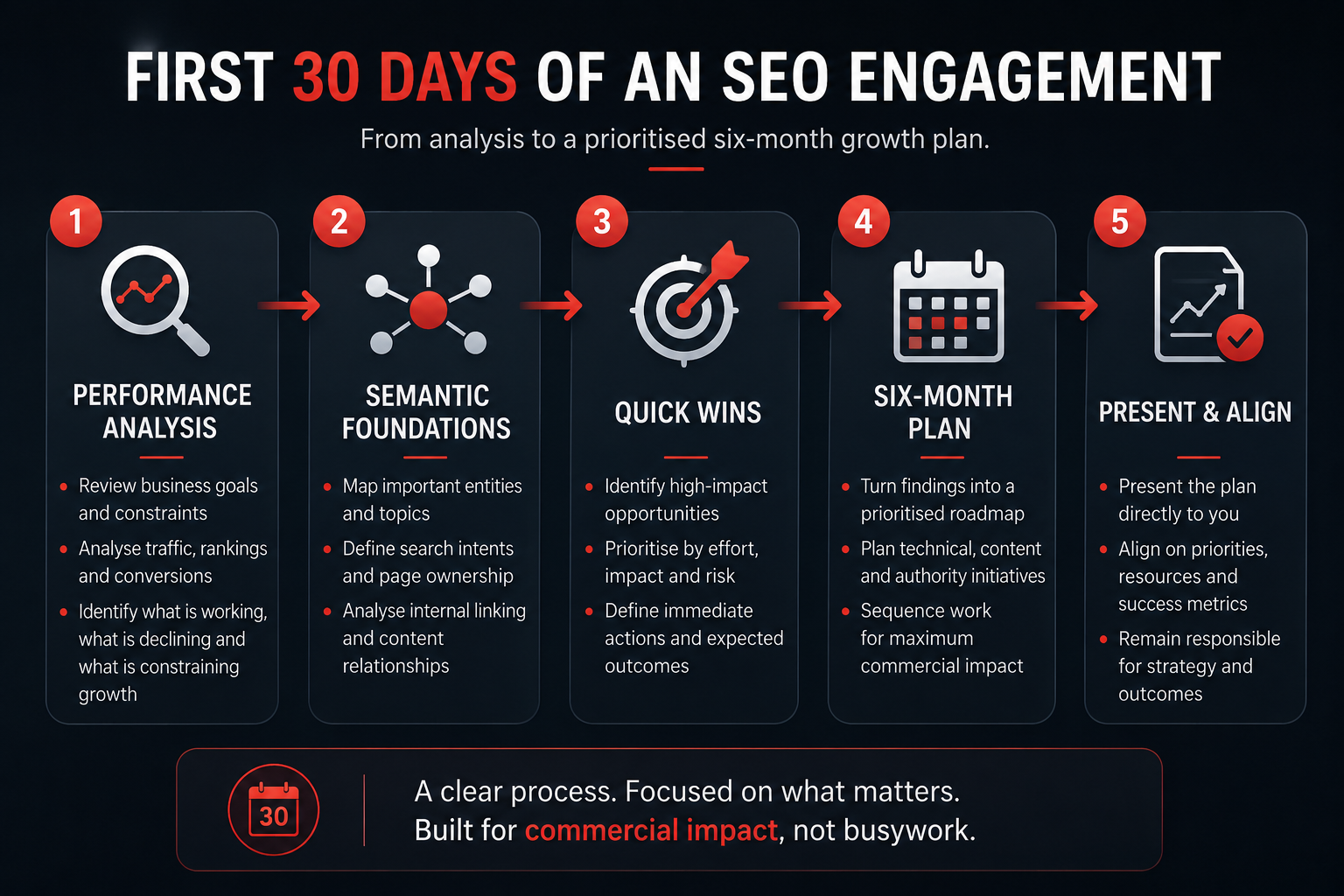
The first month of an SEO consultancy engagement normally focuses on understanding the business, diagnosing current performance, identifying the most important opportunities and turning those findings into a prioritised plan.
I explain the onboarding, diagnosis, planning and ongoing relationship in my guide to what to expect when working with an SEO consultant.
When Does an SEO Consultant Recommend Less Content?
An SEO consultant can recommend removing or consolidating content when a website has large numbers of low-value or overlapping pages competing across similar topics, rather than automatically prescribing more articles.
Fleet Evolution demonstrates the point.
The B2B salary sacrifice car provider worked with Ignite SEO to improve visibility for the phrase “Salary Sacrifice Cars”, which was ranking on page three of Google. Competitors for that phrase included Tesla and RAC.
The audit identified more than 500 cruft pages: low-quality or duplicate pages that drove no traffic to the site.
Adding another layer of content on top of them was not the answer.
The 12-week campaign removed over 500 pages, merged overlapping content, improved valuable existing pages, fixed redirection and page-speed issues, and built international public relations coverage to close the authority gap.
The published Ignite SEO case study reports:
- 31+ position improvement for “Salary Sacrifice Cars”, reaching page one above Tesla and RAC
- 286% increase in organic visits, from 2,466 to 9,598 in the reported 30-day comparison
- 159% increase in goal completions, from 179 to 464
Those results came from a wider SEO campaign, so attributing them solely to deleting pages would be wrong.
The useful lesson is narrower: more content was not automatically the solution.
When excessive, overlapping or low-value pages are part of the constraint, consolidation can produce more value than simply adding another batch of blog posts. That is why diagnosis comes before prescription.
You can read the full
Fleet Evolution B2B SEO case study
on the Ignite SEO website.
Not sure what is holding your SEO back?
More content, more links and more technical work are not automatically the answer. The useful first step is identifying the constraint.
When Shouldn’t You Hire an SEO Consultant?
You should not hire an SEO consultant when your expectations, budget and starting position make the desired outcome commercially unrealistic, or when another acquisition channel offers a substantially better route to your immediate objective.
The most common problem is a gap that is too large for the resources available.
A site with very little existing visibility or authority, operating in an extremely competitive market and expecting dominant rankings within three months on a small budget, presents economics that no consultant can change.
The distance between the current position and the target position still requires some combination of time, expertise, content, technical resources and authority.
I will also say when SEO should not be the priority.
A business that needs to validate an offer quickly will often get that answer faster from paid search, outbound or partnerships than from months of building organic visibility.
A consultant should be capable of recommending against SEO when the numbers do not support it.
How Much Does an SEO Consultant Cost?
SEO consultant pricing varies according to the consultant, scope, engagement model and level of involvement. Hourly, project-based and retained consultancy can all make sense depending on whether a business needs a specific decision, ongoing strategic direction or strategy alongside implementation.
For current UK pricing examples, methodology and an explanation of consultancy costs versus implementation costs, see my UK SEO consultant pricing guide.
Is an SEO Consultant Better Than an SEO Agency?
An SEO consultant offers direct access to specialist expertise, while an SEO agency offers greater execution capacity across a team. The right choice depends on whether your business needs strategic expertise, delivery resources or both.
How Do You Choose an SEO Consultant?
Choose an SEO consultant based on their ability to diagnose your situation, explain priorities clearly, demonstrate relevant evidence and connect SEO recommendations to business outcomes rather than the complexity of their reporting.
I’ve covered how to hire an SEO consultant in more detail, including the questions to ask and warning signs to look for.
How Long Does SEO Consultancy Take to Work?
SEO consultancy can identify useful changes immediately, but the time required to produce meaningful search results depends on the site’s starting position, competition, authority, available resources and the size of the visibility gap it needs to close.
Frequently Asked Questions About SEO Consultants
What Is the Main Role of an SEO Consultant?
The main role of an SEO consultant is to diagnose what limits a business’s organic search performance, identify the opportunities available and prioritise the work most likely to improve commercially valuable visibility.
The consultant may also execute the strategy or work alongside the client’s existing team.
What Is the Difference Between an SEO Consultant and an SEO Specialist?
An SEO specialist commonly focuses on executing SEO within particular areas, while an SEO consultant diagnoses problems, establishes priorities and provides strategic direction across the wider SEO programme.
The two terms overlap in practice and individual roles vary considerably.
Can an SEO Consultant Work With an Existing Marketing Team?
Yes. An SEO consultant can provide specialist strategy to an existing marketing, development, content or in-house SEO team while those teams handle implementation.
Hourly and advisory consultancy suit this arrangement particularly well.
Does an SEO Consultant Guarantee Rankings?
No credible SEO consultant guarantees a specific organic ranking because search results depend on competitors, search-engine systems and factors outside the consultant’s control.
A consultant should instead explain what needs improving, what success is measured against and how realistic the target is.
Do Small Businesses Need an SEO Consultant?
A small business benefits from an SEO consultant when organic search represents a commercially worthwhile acquisition opportunity but the business lacks the expertise to prioritise and execute SEO effectively.
Another channel may be a better use of the budget where search demand or economics do not justify the investment.
What Are You Hiring an SEO Consultant to Do?
You are hiring an SEO consultant to make better decisions about organic search: understand the business objective, diagnose the constraints, identify the opportunities and prioritise the work required to close the gap.
Sometimes the answer is more content. Sometimes it is less. Sometimes the constraint is technical SEO, authority, site architecture or internal linking. And sometimes SEO is not the best investment available.
Knowing the difference is the job.
Need an SEO consultant?
If you need senior SEO direction, you can see how I work as an independent SEO consultant.
Pingback: Local SEO in 2026: What Drives Google Maps Rankings & Visibility?